In the end, the chimera’s heart was not a prize to be seized but a conversation. The final repack left a scar in its rhythm—not a corrupted wound, but a remembrance burned into the song: that every rearrangement changes more than what you see, and that the true art is in learning how to live with the echoes you create.
They worked quickly. The knots unwound under patient fingers and the chest’s lid lifted like the opening of a throat. Inside were compartments of memory: things that pulsed with seasons, with births, with the smaller cheatings of drought that had been repaired with barter and bone. The chest sang when the lid parted: not words, but a syntax of pulses and impressions. Elen listened, translating with the soft skill of someone who had once read the bones during funerals. She tapped a rhythm with two fingers and the chest responded—adjusting, expecting.
Marek and the others understood, at last, that they had not been simple thieves but editors of a living book. And living books do not like being edited by people who do not understand the grammar. They had not only repacked a chest; they had repacked an ecology of forgetting and remembering. The chest would not simply return to its old pulse by snapping fingers. It had to be taught again, gradually, with humility.
Years later, children would play near the ruins and invent stories about the chest that could be opened to rearrange seasons. They told these stories with wide eyes and proper fear. A few still harbored the old hunger for absolute solutions—lessons hard-baked by famine—and would smuggle in tricks; but the ritual had taken hold. People had become librarians of their own pasts, learning that stewardship required both the daring to adapt and the humility to preserve the lines that had kept them alive.
But every system carries its debts.
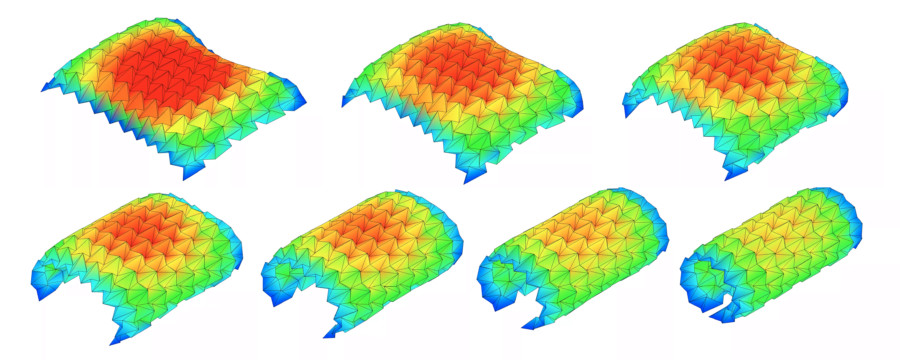
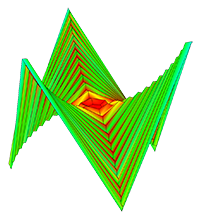
STRAIN VISUALIZATION
Cauchy strain or engineering strain is a unitless measurement of how much a material is being stretched or compressed under load.
The Strain Visualization illustrates the strain across an origami sheet by mapping it to a color from blue (no strain) to red (max strain).