
A cross platform, customizable graphical frontend for launching emulators and managing your game collection.
A cross platform, customizable graphical frontend for launching emulators and managing your game collection.



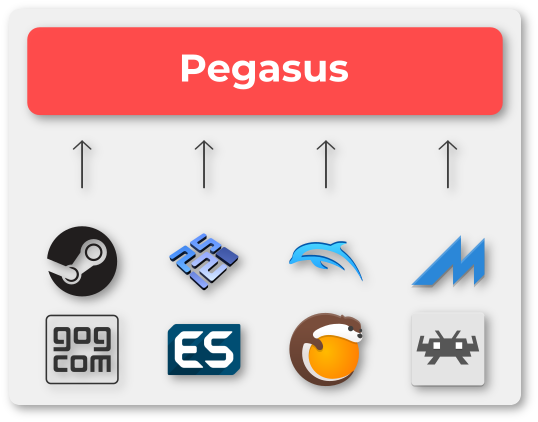
Pegasus is a graphical frontend for browsing your game library (especially retro games) and launching them from one place. It's focusing on customizability, cross platform support (including embedded devices) and high performance.
Instead of launching different games with different emulators one by one manually, you can add them to Pegasus and launch the games from a friendly graphical screen from your couch. You can add all kinds of artworks, metadata or video previews for each game to make it look even better!
With additional themes, you can completely change everything that is on the screen. Add or remove UI elements, menu screens, whatever. Want to make it look like Kodi? Steam? Any other launcher? No problem. You can add animations and effects, 3D scenes, or even run your custom shader code.
Pegasus can run on Linux, Windows, Mac, Raspberry Pi, Odroid and Android devices. It's compatible with EmulationStation metadata and gamelist files, and instantly recognizes your Steam games!

Given the nature of ACPI and the specific identifier "nsc6001", I'm going to speculate that "nsc6001" could refer to a particular piece of hardware within a system, possibly related to thermal management, a sensor, or another type of component that interacts with the ACPI for configuration and control. Feature Name: IntelliTherm
The development and integration of features like IntelliTherm highlight the evolving nature of computing, where performance, efficiency, and user experience are increasingly intertwined with sophisticated management and optimization technologies. acpi nsc6001
The string "acpi nsc6001" seems to relate to ACPI (Advanced Configuration and Power Interface) and a specific device or component identified by "nsc6001". ACPI is a standard for device configuration and power management in computers, and it is used by the operating system to configure the computer's hardware components and manage their power states. Given the nature of ACPI and the specific


